
1
Send to the shared area
When one item or a multi-selection is active, the shared-area button can copy the selected part from the workspace, group, true/false action branch, dialog, and variables surfaces into the device-local library.
No-Code Workspace — Block Reference
Sends a secure WebSocket message and collects replies
Documented for app version 1.0.50Updated:
Block Preview
Captured from the in-app Visual Builder block card in the English UI.
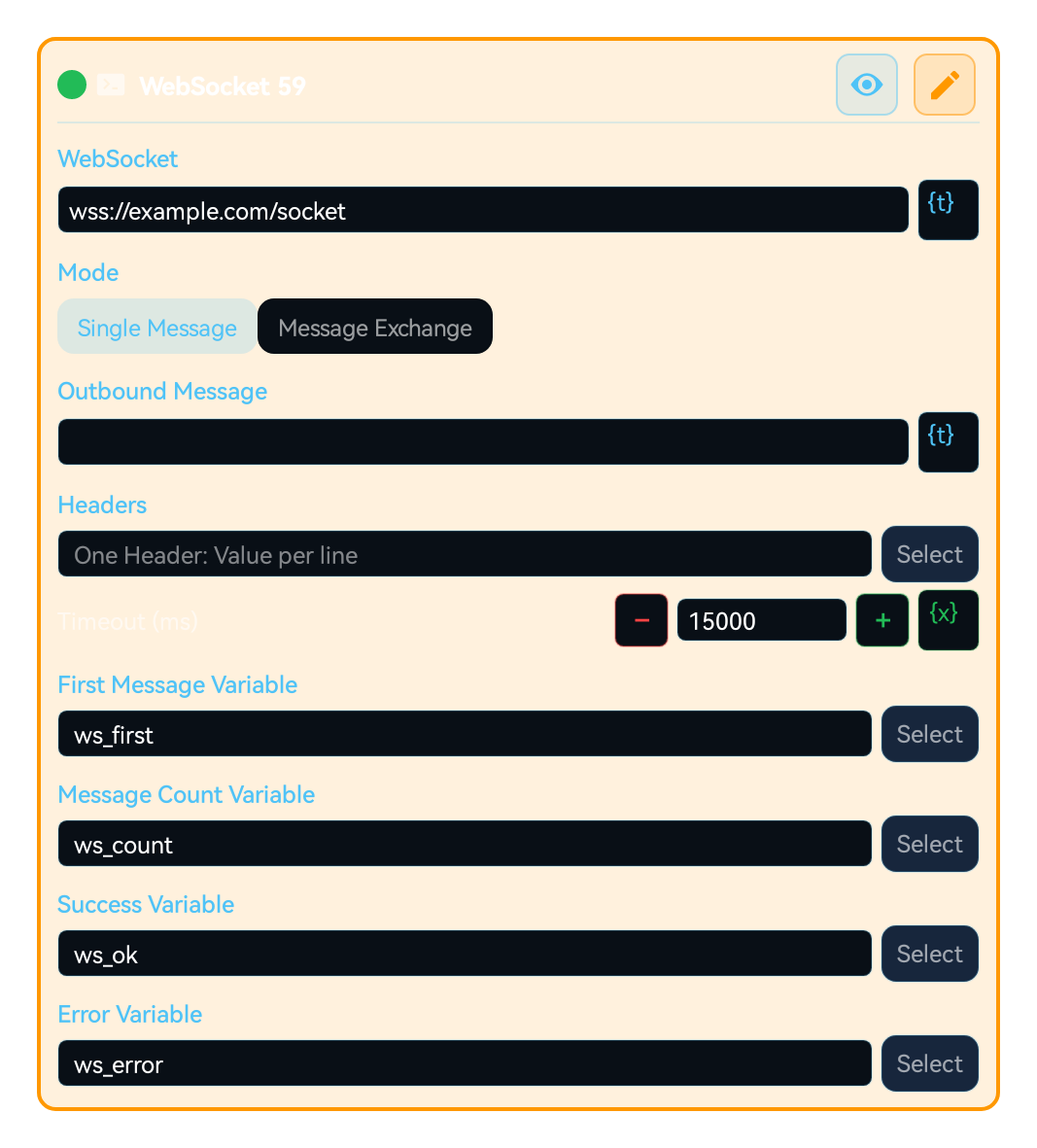
Opens a short, bounded wss:// session and sends an optional first message; writes the first reply, the message count, a success flag and the error text into variables. text mode takes the first reply, exchange mode collects several messages.
Use it to send a command and wait for an acknowledgement, or to collect several messages instead of one HTTP reply.
Pick the wss:// address and the mode
Enter the optional message ({{ }} supported) and header lines
Set the timeout and, for exchange, maxMessages
Fill resultVar, countVar, okVar and errorVar
wss:// address; text or exchange
First message and "Header: Value" lines
Wait budget and the exchange message limit
First message, count, success and error
| Parameter | Description |
|---|---|
| URL and Mode | wss:// address; text or exchange |
| Message and Headers | First message and "Header: Value" lines |
| Timeout / Max Messages | Wait budget and the exchange message limit |
| Output Variables | First message, count, success and error |
WEBSOCKET (exchange, maxMessages = 3) → if okVar is false, LOG "{{wsError}}" → validate the reply with JSON_PARSE
COMBINATIONS:
WEBSOCKET + JSON_PARSE: Extract the reply
WEBSOCKET + IF_ELSE: Branch on okVar
Sends a secure WebSocket message and collects replies
WARNING:
Only wss:// addresses outside internal networks are accepted
It is not a permanent subscription; use the code editor for long-lived listening
The same block at three levels: a quick start, the real options, and professional techniques.
WEBSOCKET opens a short-lived, bounded secure socket session: it sends an optional first message to a wss:// address and collects the reply. As output, it writes the first message, the total message count, a success flag, and an error string into separate variables. Use it when you need a live command/ack exchange instead of a single HTTP response. It does not build a permanent socket layer — it runs one controlled wss transaction.
Enter the full wss:// address in the URL field. Mode has two options: text gets and returns the first reply; exchange collects multiple messages and uses maxMessages to cap how many before stopping. Message is the first outbound payload; header lines use the "Header: Value" format for the handshake. Timeout is the wait budget for the whole transaction. Output variables: resultVar (first message), countVar (total count), okVar (success flag), errorVar (error text). At runtime this maps to WebSocket.exchange(url, message, maxMessages, timeout, headers) returning .first/.count/.ok/.error.
Treat okVar like a gate: before trusting the raw reply, check ok is true with IF_ELSE or COMPARE, and if not, log errorVar and exit cleanly. Don't process the first reply (resultVar) blindly — validate the ack field you expect with JSON_PARSE or REGEX_MATCH, so an unexpected message from the remote end keeps the flow stable. In exchange mode, set maxMessages to the number you actually expect; too high a value just waits until Timeout for nothing. This block isn't for a permanent subscription; for continuous listening or long-lived streams, the coded runtime in CUSTOM_CODE is more appropriate. Design commands to be idempotent — on a network drop the same 'start' may go twice.
Small, reproducible examples that combine several blocks — build them straight into your own macro.
This block is useful on its own — but it shines when paired with the right partners.
Turns the first socket reply into structured data so you can safely validate the ack field and branch.
Uses okVar as a gate, routing the flow to the error path when the success flag is false.
Recovers from a network or protocol fault, keeping the macro controlled when the socket transaction fails.
Shows the collected live state on screen, giving the operator instant feedback.
Branches on the extracted ack or status value, confirming the command was actually accepted.
Entering a ws:// address. The block only accepts wss://; plain ws or hosts pointing at the internal network are rejected. Fix: use a secure wss:// address.
Processing resultVar without checking okVar. On failure the first message may be empty or misleading. Fix: validate okVar first with IF_ELSE/COMPARE.
Trying to use this block for permanent listening/subscription. It runs a bounded transaction, not a continuous stream. Fix: use the CUSTOM_CODE coded runtime for long-lived needs.
In exchange mode, set maxMessages to the count you actually expect; an unnecessarily high value just waits until Timeout for nothing.
Instead of trusting the raw first reply, run a small JSON_PARSE or REGEX_MATCH validation; it hardens the flow against unexpected messages.
Design the command you send to be idempotent; on a network drop the same 'start' can go twice, so the remote end should dedupe.
The Lua below is what the Code Editor generates for this block with sample settings. Adding cases, branches, actions or loops, or changing settings, extends the generated code accordingly. Study it to see what the block does under the hood, to learn Lua, or to copy and adapt it. Use the Copy button (top-right) to paste it into the Code Editor, or “Try in Editor →” to run it in the live editor.
local ws_first = nil
local ws_count = nil
local ws_ok = nil
local ws_error = nil

local _ws1 = WebSocket.exchange("wss://example.com/socket", "{\"ping\":true}", 2, 15000, nil)
ws_first = _ws1.first
ws_count = _ws1.count
ws_ok = _ws1.ok
ws_error = _ws1.error
Note: generated code can evolve across versions; helper names (e.g. _reg1, m1) and internal optimizations may change. The logic and the called APIs reflect the block’s behavior.
The guidance below is not identical for every block. It summarizes the professional controls that most often repeat in the selected block family.
SYSTEM and PANEL_CONTROL first choose a command type; the rest of the fields only make sense in that context.
arg1/arg2 or panel fields do not mean the same thing across every command; fill them according to that command.
Testing risky system actions with LOG or NOTIFY before going live makes builder flows safer.
Add short waits after app launches, panel state changes, or settings-navigation steps.
TOUCH and TOUCH_BREAK cover recipe-style touch flows. Raw pointer choreography such as Touch.down, Touch.move, Touch.up, Touch.dispatch, Touch.reset, Touch.breakAll, and Touch.releaseAfter is not exposed as a first-class builder block.
Touch.downTouch.moveTouch.upTouch.dispatchTouch.resetTouch.breakAllTouch.releaseAfterThe DIALOG block and dialog designer cover a bounded field set in the builder: Info Text, Text Input, Checkbox, Description, Radio Group, Dropdown, Multi Select, Tab Group, Date Time, Number Range, Slider, Image Picker, Color Picker, File Picker, Recorder Picker, Tag, Signature, and Spacer. The buttons are designed too: the Positive button and Negative button tabs set each button’s text, background, and border color, corner radius, and minimum height next to a preview. Freer Setting.builder composition, multi-step wizard flows, and mixed HUD/dialog choreography still do not map 1:1 into the builder.
Coming soonv1.0.51Two more fields: Agent Detect references (agent_detect_editor) lets the user pick a saved reference set or add and edit references, and Save confirms the selection; Navigation setup editor (navigation_editor) edits a saved map, marker and route from the Dialog and returns the setup and route selection without moving the character.
Setting.builderDialogHudTextViewAgentDetectEditorNavigationEditorHTTP_GET, HTTP_POST, and HTTP_PUT cover common fixed-method flows; HTTP_REQUEST covers one bounded request with method, header lines, body, content type, query parameters (GET and DELETE), timeout, and a bounded retry. These blocks never throw; they write the status code (-1 on a network failure). Cookie handling, chained request objects, and lower-level client flows still need the code editor.
Request()Request.setCookieRequest.getCookiesCUSTOM_CODEThe MAP, LIST, JSON_PARSE, REGEX_MATCH, and METRICS blocks cover the everyday cases: map actions, a static list, reading a value from a JSON path, regex match, find, replace, and split, and metrics actions. The rest of the Map, Array, JSON, Regex, and Metrics APIs (for example Array sort, filter, and map) is broader than the builder recipe model and stays on the CUSTOM_CODE and code editor side.
MapArrayJSONRegexMetricsRuntime helpers, raw Request objects, Lua built-ins such as print/pcall/xpcall, and free-form object chaining patterns are represented through CUSTOM_CODE or the code editor.
RuntimeRequestprintpcallxpcallCUSTOM_CODEEach block card now exposes an independent breakpoint toggle. When enabled, the breakpoint preference is stored with the block.
Breakpoints are only emitted into runtime code when Debug Mode is enabled from Visual Builder settings. When Debug Mode is off, breakpoints stay saved but do not pause execution.
Use ASSERT for fail-fast validation, and use breakpoints for step-by-step tracing and controlled pauses in the same flow.
Variables defined with SET_VARIABLE are accessible throughout the macro (global scope). All blocks can read/write the same variable.
However, a variable defined inside a GROUP will be 'nil' (undefined) until the GROUP executes. Blocks outside the GROUP using this variable may produce unexpected results.
FOR_EACH loop variables (item and index) only carry valid values inside the loop body. Outside the loop they are outside local scope and should not be used.
TRY_CATCH error variable is only valid within the catch block. If the try block succeeds, the catch branch is not entered and the error variable remains undefined.
TIP: Before using a variable inside a GROUP, assign a default value with SET_VARIABLE outside the GROUP. This way the variable won't be nil even if the GROUP has not run.
You can embed variable values and calculations into text fields using {{ expression }} syntax. Expressions inside double curly braces are evaluated as Lua code and the result is inserted into the text.
{{ expression }}Skor: {{ score + 1 }} → "Skor: " .. tostring(score + 1){{ name }} kazandı! → tostring(name) .. " kazandı!"X:{{ x }} Y:{{ y }} → "X:" .. tostring(x) .. " Y:" .. tostring(y)Expressions are checked by the sandbox policy. Security-sensitive calls like loadstring, require, debug are automatically blocked.
Keep scan regions as small as possible — improves speed, reduces false matches.
Always add an exit condition when using infinite loops (BREAK, timeout, or conditional exit).
Use network operations and error-prone steps inside TRY_CATCH.
If you need global error handling, use the Error Handler (ERROR_HANDLER) block as a singleton in the project.
Small coordinate offsets (CLICK/SWIPE) improve tap accuracy across different DPI and screen scales.
Customize macros with Dialog block — different parameters each run.
Define repeating steps once with GROUP_CALL, call from many places.
Cross-macro local library
The Local Shared Macro Area moves blocks, variables, dialog fields, gallery assets, and imported media dependencies between macros on the same device. It is device-local, not cloud sync, not Firebase sharing, and not a replacement for public macro sharing.
Professional usage model: put a reusable login flow, common scan region, shared dialog form, variable group, template image, color profile, replay recording, or imported PLAY_SOUND media file into the shared area from one macro, then import it from the relevant + menu in another macro.
VISUAL_BLOCKSVARIABLESDIALOG_FIELDSTEMPLATE_IMAGECOLOR_SWATCHREPLAY_RECORDMEDIA_FILEWhen one item or a multi-selection is active, the shared-area button can copy the selected part from the workspace, group, true/false action branch, dialog, and variables surfaces into the device-local library.
The shared-area entry under the + menu imports the selected item into the surface that opened it. Main workspace, group, action branch, dialog, and variables each receive the compatible item type.
Gallery items include template images, color swatches, replay records, and imported audio/media files. They can move between macros on the same device so repeated templates, colors, recordings, and PLAY_SOUND media assets do not need to be captured again.
The shared area is not a permanent dumping ground. Delete stale shared items from the shared-library panel; imports create a copy in the target macro and do not rewrite the source macro flow.
AI assistant
Tell MH AI what you want in plain language; it proposes the right block sequence and lands it in the workspace after you approve. In the current release it works with cloud providers such as Gemini, Claude, and OpenAI; on-device local models are on the roadmap.